 Dymension
: RollApp settlement, token launches and shared liquidity
Dymension is a Layer 1 blockchain that connects application-specific chains, called RollApps, through shared settlement and token transfers. Each RollApp handles its own transactions while the Hub coordinates settlement. Sequencers publish transaction data to separate data availability networks for verification. The ecosystem also includes token launches, liquidity pools, DYM staking and governance.
What's inside
This modular design gives applications control over their execution environment and token economics. It also creates separate dependencies: producing RollApp blocks, recording their state on the Hub and keeping transaction data available each contribute different parts of the system.
RollApp execution and Hub settlement
Application-specific execution
A RollApp runs application logic in its own execution environment, while the Hub maintains shared settlement records. Supported environments include the Ethereum Virtual Machine (EVM) and CosmWasm. Their execution rules differ, so application compatibility follows the environment that a chain uses. Separate execution lets a RollApp configure its own application economy. Games, decentralized finance and other applications can use this structure, with functionality determined by their actual software.
Sequencing and state commitments
A sequencer orders transactions and produces RollApp blocks. It batches those blocks and publishes their data to the chosen data availability network. After that network accepts the publication, the sequencer submits a state update to the Hub. The update includes state roots and metadata that connect the commitment to its underlying data. A state root is a compact commitment to the chain’s state. Hub validators maintain the settlement chain, while RollApp operators handle the separate execution workload.
A fast RollApp confirmation and a finalized Hub settlement record describe different points in the same transaction history.
How can a token become a RollApp?
Trading before chain launch
An Initial RollApp Offering (IRO) can establish a token market before the associated chain begins operating. Creators configure token economics, a pricing curve and launch conditions. The v4.0.0 Hub implementation allows IROs to raise DYM or other configured tokens and graduate into a liquidity pool. The curve governs pricing before pool graduation, while an operating chain also needs a sequencer and an execution environment.
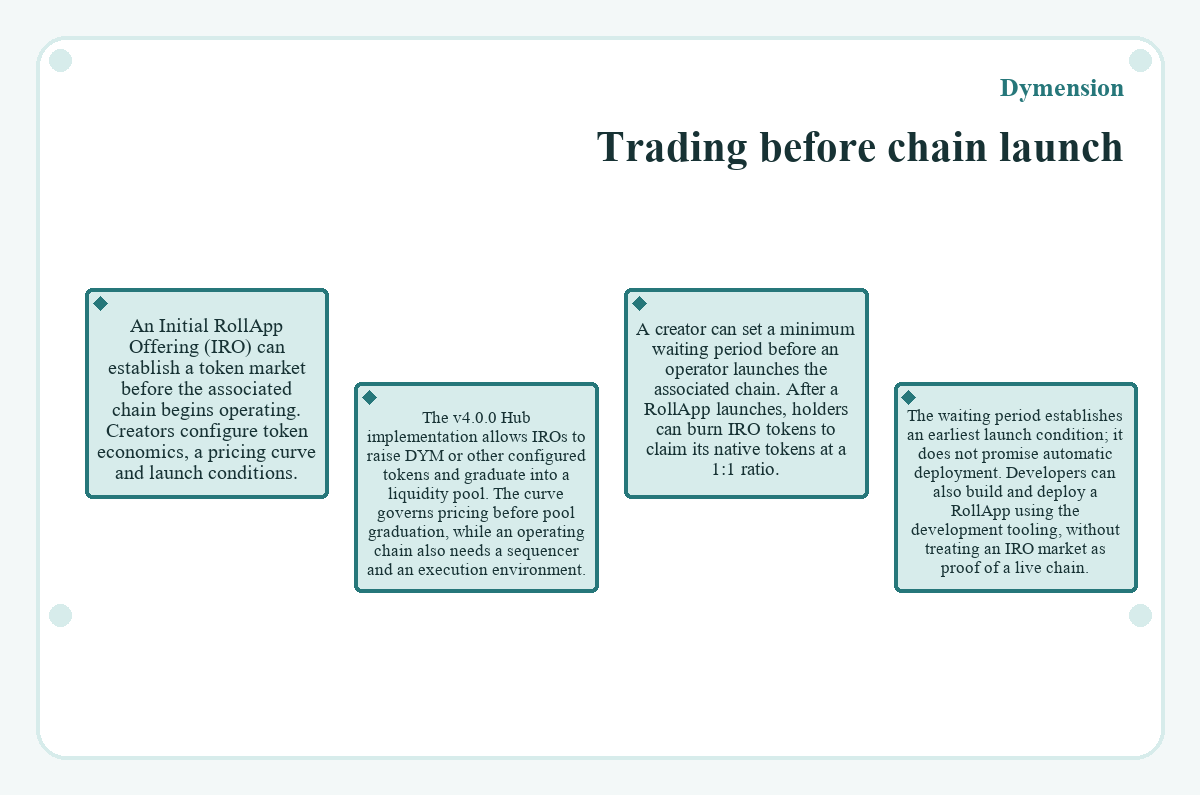
A creator can set a minimum waiting period before an operator launches the associated chain. After a RollApp launches, holders can burn IRO tokens to claim its native tokens at a 1:1 ratio. The waiting period establishes an earliest launch condition; it does not promise automatic deployment. Developers can also build and deploy a RollApp using the development tooling, without treating an IRO market as proof of a live chain.
A pre-launch token and an operating chain
In this hypothetical case, an IRO token trades while its associated RollApp has not launched. The token gives its holder a claim to native tokens after launch. Trading occurs on the Hub, so the visible token market demonstrates trading activity. It does not demonstrate that the future RollApp already runs applications.
If an operator launches that RollApp under its configured conditions, holders can redeem their pre-launch tokens. They gain access to the native chain asset, and the RollApp supplies an operating execution environment. If the chain never launches, the condition for post-launch redemption remains unmet.
Development and operation tools
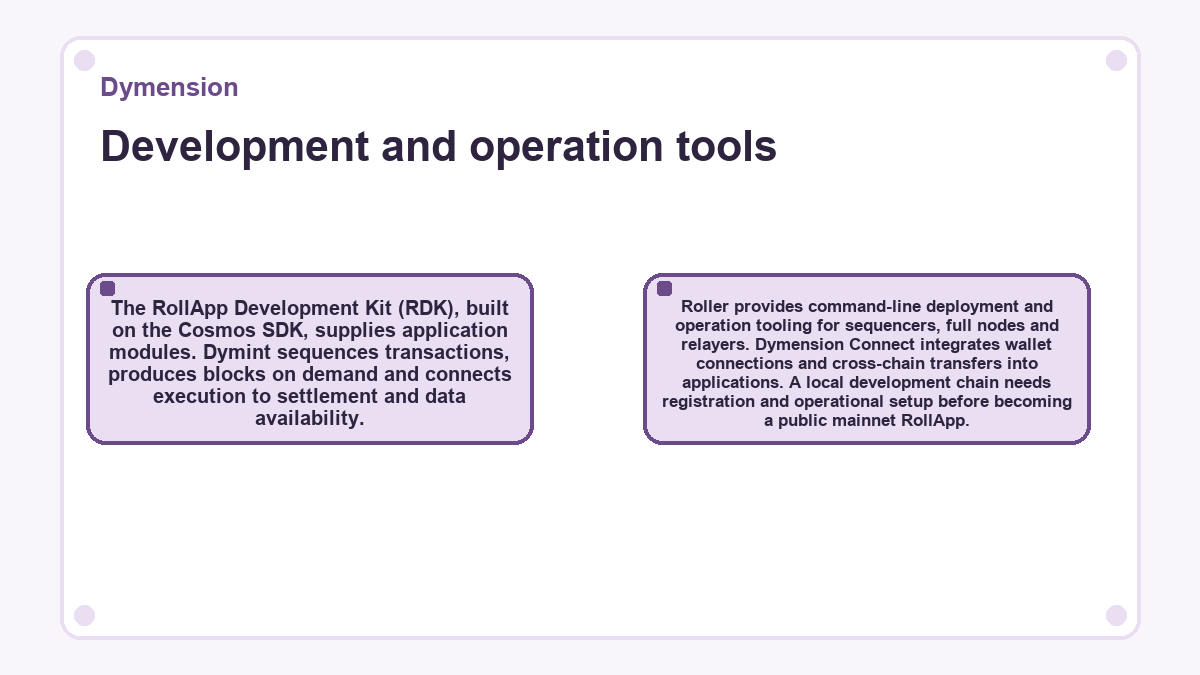
The RollApp Development Kit (RDK), built on the Cosmos SDK, supplies application modules. Dymint sequences transactions, produces blocks on demand and connects execution to settlement and data availability. Roller provides command-line deployment and operation tooling for sequencers, full nodes and relayers. Dymension Connect integrates wallet connections and cross-chain transfers into applications. A local development chain needs registration and operational setup before becoming a public mainnet RollApp.
What does DYM do within the network?
DYM pays Hub transaction fees and underpins its staking and governance system. DYM holders can delegate tokens to validators that participate in the Hub’s proof-of-stake consensus. Validator commission and token issuance affect rewards, and governance can adjust parameters and authorize community spending. Stakers also direct incentives through endorsements. The v4.0.0 Hub implementation restricts endorsement votes to RollApp reward allocations; the general documentation also describes liquidity-pool endorsements. Sequencer bonds back operators’ state commitments. Issuance adds tokens to supply, while protocol fee burns remove them.
How do transfers and swaps connect RollApps?
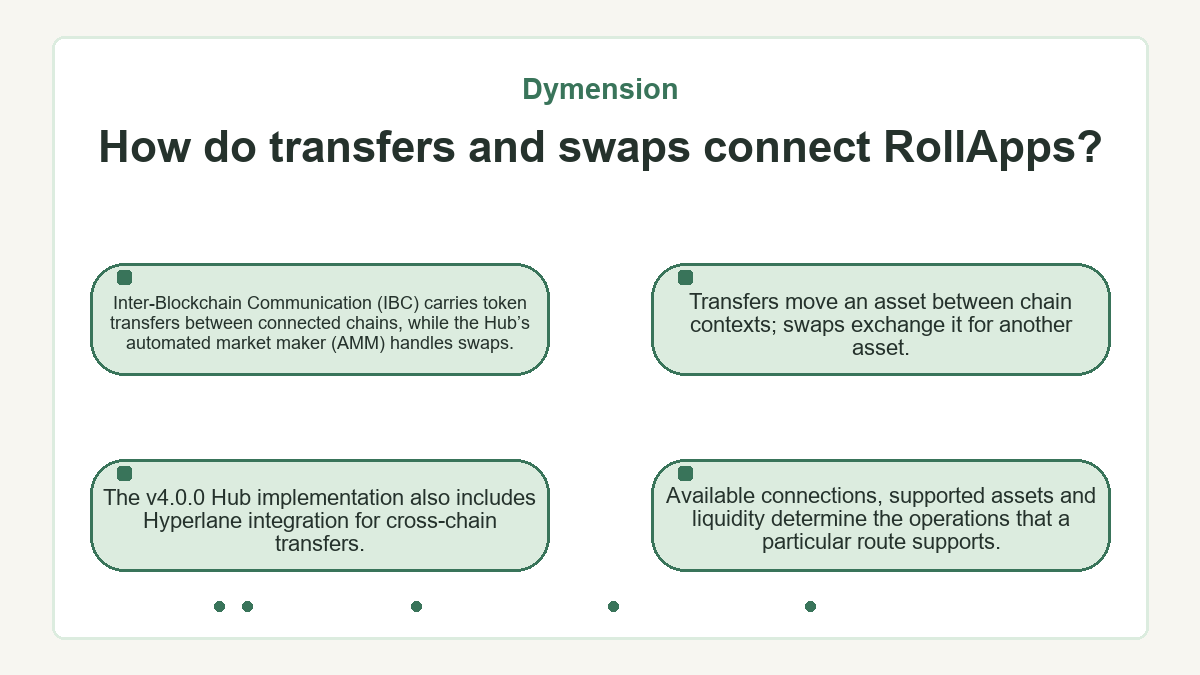
Inter-Blockchain Communication (IBC) carries token transfers between connected chains, while the Hub’s automated market maker (AMM) handles swaps. Transfers move an asset between chain contexts; swaps exchange it for another asset. The v4.0.0 Hub implementation also includes Hyperlane integration for cross-chain transfers. Available connections, supported assets and liquidity determine the operations that a particular route supports.
Transfers and withdrawal timing
Relayers deliver cross-chain messages, and light clients check the relevant chain state. RollApp deposits use protocol-level bookkeeping on the Hub. A withdrawal under dispute-period settlement waits until its corresponding state satisfies finalization requirements. Applicable network parameters govern that wait, so local block production speed does not establish withdrawal completion. A connected IBC channel and functioning relaying remain dependencies for cross-chain delivery.
eIBC adds a market for filling withdrawal requests before that finalization completes. A liquidity provider supplies tokens in exchange for a priority tip. Early payment depends on an order actually receiving liquidity and fulfillment. The underlying RollApp state still follows its settlement rules; eIBC changes who waits for it. Only funds used to fulfill orders are tied up during the applicable dispute period; unused liquidity remains available. If an invalid RollApp state goes unreported, providers that filled withdrawal orders can lose funds.
Pool pricing and liquidity costs
The AMM prices trades from pool balances, with standard two-token pools using a constant-product model. A trade changes the reserve ratio and therefore the price for subsequent trades. Trade size relative to available liquidity influences price impact. Protocol swap fees and liquidity-provider fees also affect the amount received. A multi-hop swap can use several pools within a single transaction.
Providing pool liquidity gives a participant a share of pool assets and exposure to their changing relative prices. That differs from supplying eIBC liquidity, which funds withdrawal orders while settlement remains pending. Creator royalties and pool-provider revenue go to different participants; protocol fee burns reduce DYM supply. The applicable configuration sets each activity’s rates. Pool incentives require an allocation and eligible bonded pool shares; ordinary swap-fee revenue comes from trading activity.
Data availability and the limits of shared security
Shared settlement leaves RollApps dependent on their sequencers, data availability networks and application logic. External data lets full nodes reconstruct execution and compare resulting state with a sequencer’s commitments. This checking depends on access to the transaction data that produced those commitments. Publication costs and data availability therefore affect chain operation even when application execution happens elsewhere.
Data availability networks may prune transaction data. Archival retention supports later retrieval, while publication makes data available for verification.
Dymension RollApp Standards (DRS) restrict supported chain software to approved binaries, and governance can approve additional standards. These rules constrain changes to core transfer logic. Applications built on that software retain their own contract behavior and economic risks. A correctly executed application transaction can still produce a loss through the application’s rules.
The v4.0.0 Hub implementation supports optional attested finalization through a trusted execution environment (TEE). This path requires a valid attestation, the RollApp owner’s opt-in and permissive global configuration. Attestation can affect when the Hub finalizes a state update; eIBC addresses early withdrawal payment through liquidity provision.
Automatic fraud-proof validation requires support for the RollApp’s execution environment in the deployed implementation. Sequencer liveness affects application availability: if the active sequencer stops producing blocks, RollApp activity can halt while Hub validators continue working.
Dymension: frequently asked questions
-
Is Dymension an Ethereum Layer 2?
- Dymension is its own Layer 1 blockchain, with its own validator consensus and settlement protocol. EVM compatibility describes an execution environment; it does not mean that Ethereum provides the Hub’s consensus. RollApps settle through the Hub, while their chosen data availability networks serve a separate purpose.
-
Can a RollApp charge gas in a token other than DYM?
- RollApps support custom gas tokens through their token design. DYM’s role in Hub fees does not make it the mandatory gas asset for every application chain. The RollApp’s configured gas denomination determines which token pays for execution there, separately from fees that an operation incurs on the Hub.
-
Do DYM stakers have to follow their validator’s governance vote?
- DYM stakers can cast their own governance vote and override their validator’s vote for their delegated stake. When a staker does not vote, the validator votes on their behalf. Delegation gives a validator consensus weight while preserving the delegator’s ability to participate directly in governance.
-
Why does a Dymension account have hexadecimal and Cosmos-style addresses?
- Dymension supports hexadecimal and Cosmos-style addresses as representations of account address data. Its interfaces and APIs can expect different formats, so an address that a wallet displays may differ from the form that a service requests. The format changes the representation, not the underlying account identity.
-
Does one-to-one IRO redemption guarantee an unchanged token price?
- The 1:1 redemption ratio describes token quantities, not a fixed market price. An IRO’s configured curve determines prices during curve trading, while pool balances influence prices after graduation into a liquidity pool. A holder can receive the corresponding quantity of native tokens after launch without preserving the earlier purchase price or market value.